
Using science and sense to collectively thrive

I’m a team-weaver working as a researcher, teacher, and designer and co-building immersive (off- and online) developmental spaces that promote flourishing. After 20 years as a developmental psychologist in academia, I left the ivory tower to accelerate and amplify the real-world impact of our scientific work and directly improve the lives of young people. I’m also a mother of twin boys that have just hit adulthood. I’m writing a book that combines developmental psychology, pragmatic philosophy, Indigenous wisdom traditions, and feminist care ethics to help parents re-imagine and reinvigorate relationships with their adult “children.” I’m thinking a lot about how we shift our roles as individual caretakers to community mentors and elders who serve the next generation of young adults.
I belong to several glorious creative collectives: 1. Liminal Learning, a comprehensive world-readiness program that prepares young people (ages ~18–24 years) to thrive in an unpredictable world in flux; 2. Coralus, a community of change-makers activating cross-sector global transformations through radical generosity; 3. GEMH (Games for Emotional and Mental Health) Lab, an R&D collective of scientists, designers, and artists focused on tech for flourishing; and 4. Bloom, a group of earnest generalists who met at the start of the pandemic and happened upon an alchemy fed by friendship, art, the love of learning, & lots of play.
What We Are Building
Liminal Learning offers a comprehensive world-readiness program that prepares young people (ages ~18–24 years) to thrive with purpose in a world in flux. Young people need strong friendships, connection to land, a sense of agency, and trusted mentors they can build a future with. We combine evidence-based, developmentally-sensitive curriculum with practical collaboration tools, equipping young people to navigate life with skill, creativity, and optimism. Underpinning our curriculum is a methodology we call Neither/Nor, a philosophy and methodology that guides students towards distinguishing between intellect and intuition and how to use both with skill and flexibility. They leave with the questions that will guide their creative aspirations and with peers who share their drive for real-world impact.
Current Work

I spend about half of my time as a scientist and researcher at McMaster University (in Canada) and I’m the Director for the Games for Emotional and Mental Health (GEMH) Lab (in the Netherlands). The lab aims to build and empirically test digital games and apps that are based on solid behavioural science and combine data-driven design with stunning art that insures we retain, delight, and inspire users.

The other half of my efforts are dedicated to transformative collaborations with social entrepreneurs and leaders in education. I run workshops, courses, and culture-change curricula that provide hybrid solutions to some of the biggest challenges we face in the digital age. We come together to build strategies that combine digital and face-to-face energy so that organizations can go beyond productivity and achievement statistics to focus on psychological thriving, mental health, and social connection.

My portfolio of projects and partnerships are diverse, but they are all underpinned by an “effective optimism” approach. That is, I am fiercely optimistic about the future of work, learning, and community-building, but this optimism is grounded in science and participatory research.
Useful Links
For a list of my publications and media contacts, please see: https://gemhlab.com/researcher/isabelagranic
For my research lab’s publications, research projects, evidence-based games, and videos that explain our mission in its various manifestations, see: www.gemhlab.com
For my Google Scholar profile, see: https://scholar.google.com/citations?user=4T5cjVIAAAAJ&hl=en
I’m also Chief Science Officer of The PlayNice Institute, an organization that seeks to build and distribute evidence-based games that promote emotional health and well-being for children and youth; for more information, see: https://www.theplayniceinstitute.com/
Blog Posts
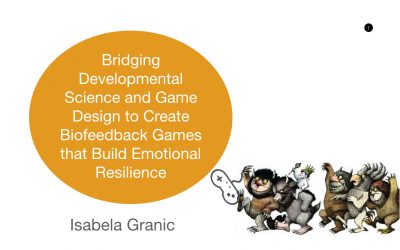
My talk at RE:Publica
Here's a 30-min run-through of some of our research that is most exciting me these days. You can't hear the audience, but they were super into the material, ooh and ahhing at the videos, and generously chuckling at my slip-ups. An overall fabulous conference with the...
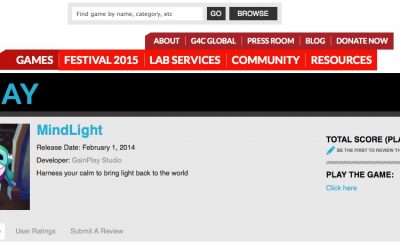
MindLight has been nominated for Most Significant Impact!
I'm honoured and thrilled that Games for Change has nominated MindLight as one of the three games up for the Most Significant Impact award. Check out the rest of the nominees here: http://www.gamesforchange.org/festival/gameplay/
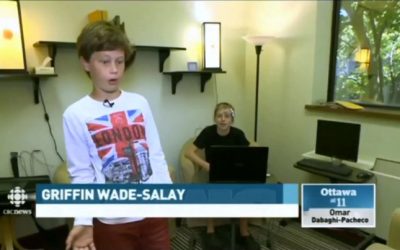
CBC News: New studies on MindLight
New studies are starting up at Queen's University with Tom Hollenstein! CBC did a great little piece summarizing what we're doing. So excited to be working with my colleague and friend on this new generation of studies. Check it out:...